Как подключить postgresql intellij idea
IntelliJ IDEA Ultimate Edition имеет удобные средства работы с базами данных. Рассмотрим, как подключиться к HSQLDB с ее помощью. Запустите IDEA и откройте панель Database.
Создайте новый источник данных с помощью контекстного меню.
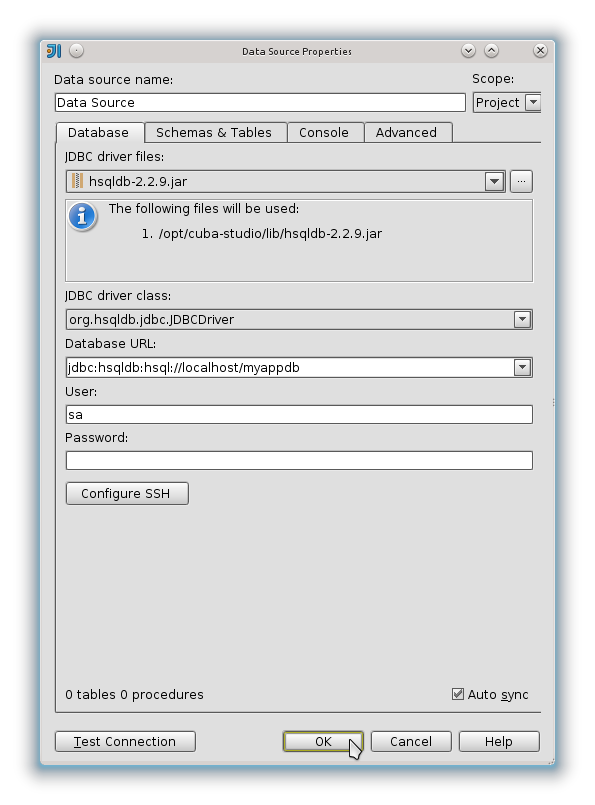
В открывшемся окне выберите драйвер hsqldb-x.x.x.jar который вы можете скопировать из подкаталога lib каталога установки CUBA Studio.
Далее необходимо указать свойства источника данных: Dаtabase URL, пользователя и пароль. Database URL можно найти на вкладке Project properties в CUBA Studio или скопировать из файла modules/core/web/META-INF/context.xml проекта. По-умолчанию пользователь — sa, пароль отсутствует.
Если вы используете PostgreSQL в качестве СУБД и uuid в качестве идентификатора, то при редактировании данных в IntelliJ IDEA может возникнуть ошибка ERROR: operator does not exist: uuid = character varying .
Для решения этой проблемы в настройках источника данных перейдите на вкладку Advanced и присвойте свойству stringtype значение unspecified .
Intellij Idea connect to PostgreSQL

Connecting IntelliJ IDEA to a PostgreSQL database is crucial for efficient database management. This article provides a step-by-step guide on establishing the connection, including downloading the PostgreSQL database connection driver and configuring the connection settings within IntelliJ IDEA. By following these instructions, you can seamlessly integrate your database operations into your development environment, enhancing productivity and streamlining your workflow.
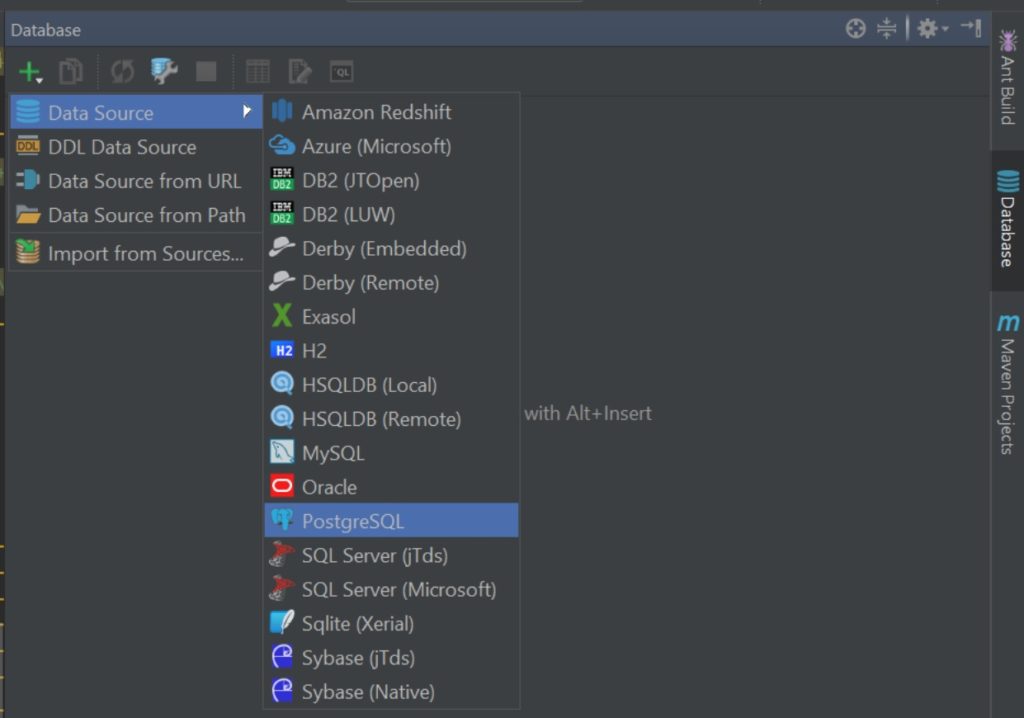
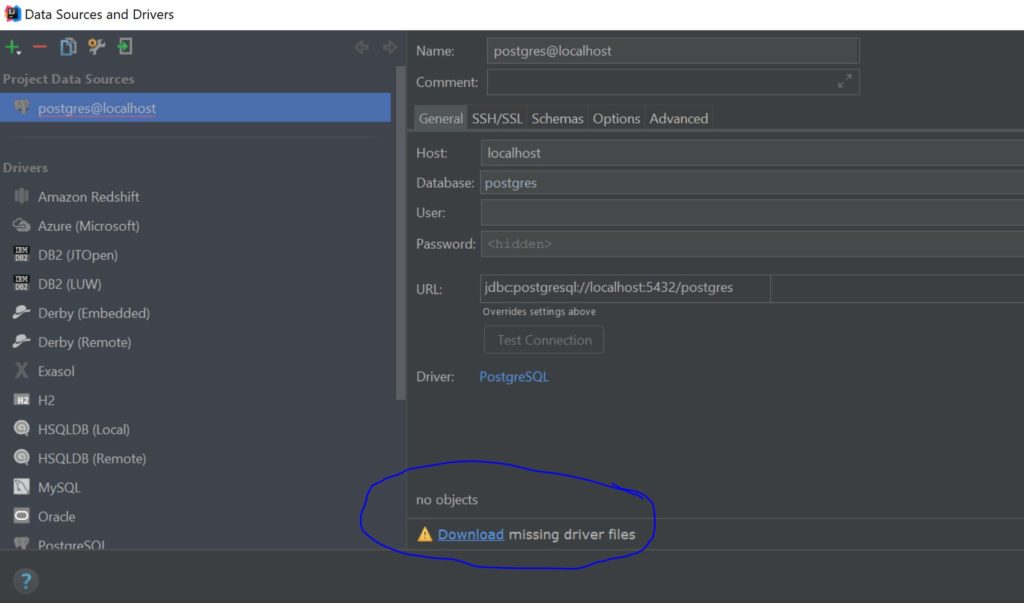
Download the database connection driver from the link in Intellij Idea.
After completing these steps, IntelliJ IDEA will be connected to your PostgreSQL database, and you can start working with it in the IDE. The database connection will be available in the “Database” tool window, allowing you to view tables, execute queries, and perform other database-related tasks directly from IntelliJ IDEA.
PostgreSQL
This functionality relies on the Database Tools and SQL plugin, which is bundled and enabled in IntelliJ IDEA by default. If the relevant features aren’t available, make sure that you didn’t disable the plugin.
The Database Tools and SQL plugin is available only in IntelliJ IDEA Ultimate.
- Press Control+Alt+S to open the IDE settings and then select Plugins .
- Open the Installed tab, find the Database Tools and SQL plugin, and select the checkbox next to the plugin name.
Official documentation and software
- For full information about PostgreSQL, refer to the official documentation.
- To download PostgreSQL database software, refer to the official software downloads.
This topic presents a general procedure on how you can create a data source for the connection to your PostgreSQL database in IntelliJ IDEA, and run a test connection. It is assumed that you already have the necessary prerequisites and the database is up and running. For example, if you want to run a database on your machine and connect to that database, the corresponding DBMS software must be installed on the machine first.
Connect to a PostgreSQL database
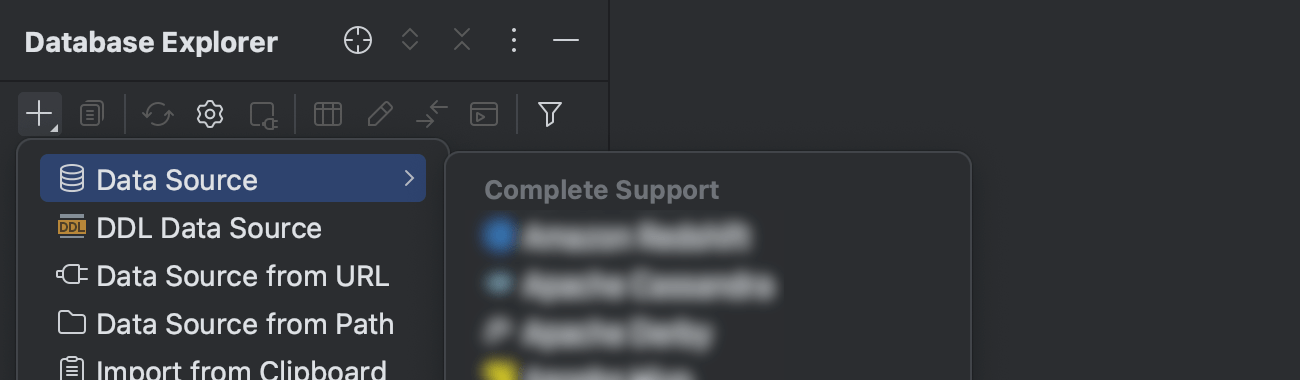
- To connect to the database, create a data source that will store your connection details. You can do this using one of the following ways:
- From the main menu, navigate to File | New | Data Source and select PostgreSQL .
- In the Database tool window ( View | Tool Windows | Database ) , click the New icon () in the toolbar. Navigate to Data Source and select PostgreSQL .
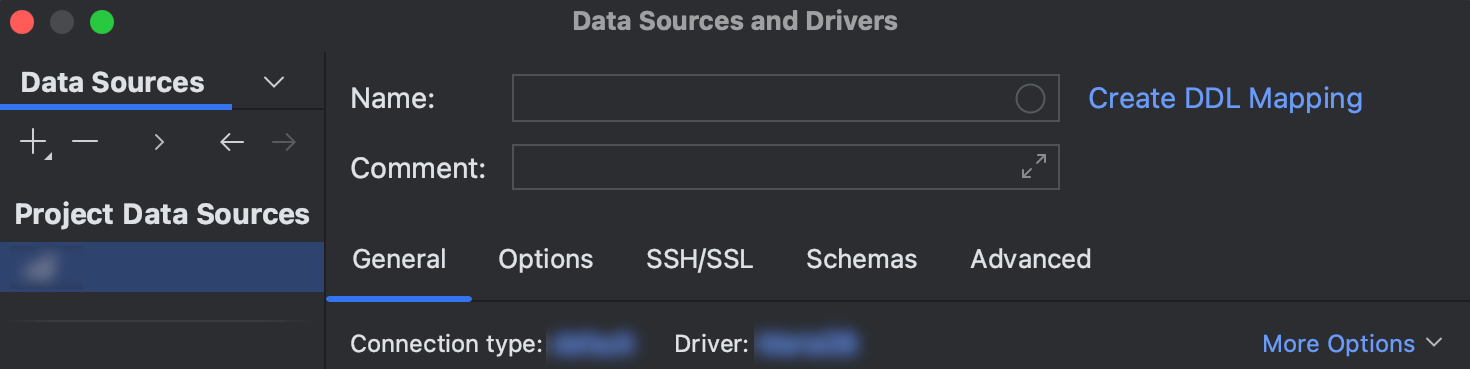
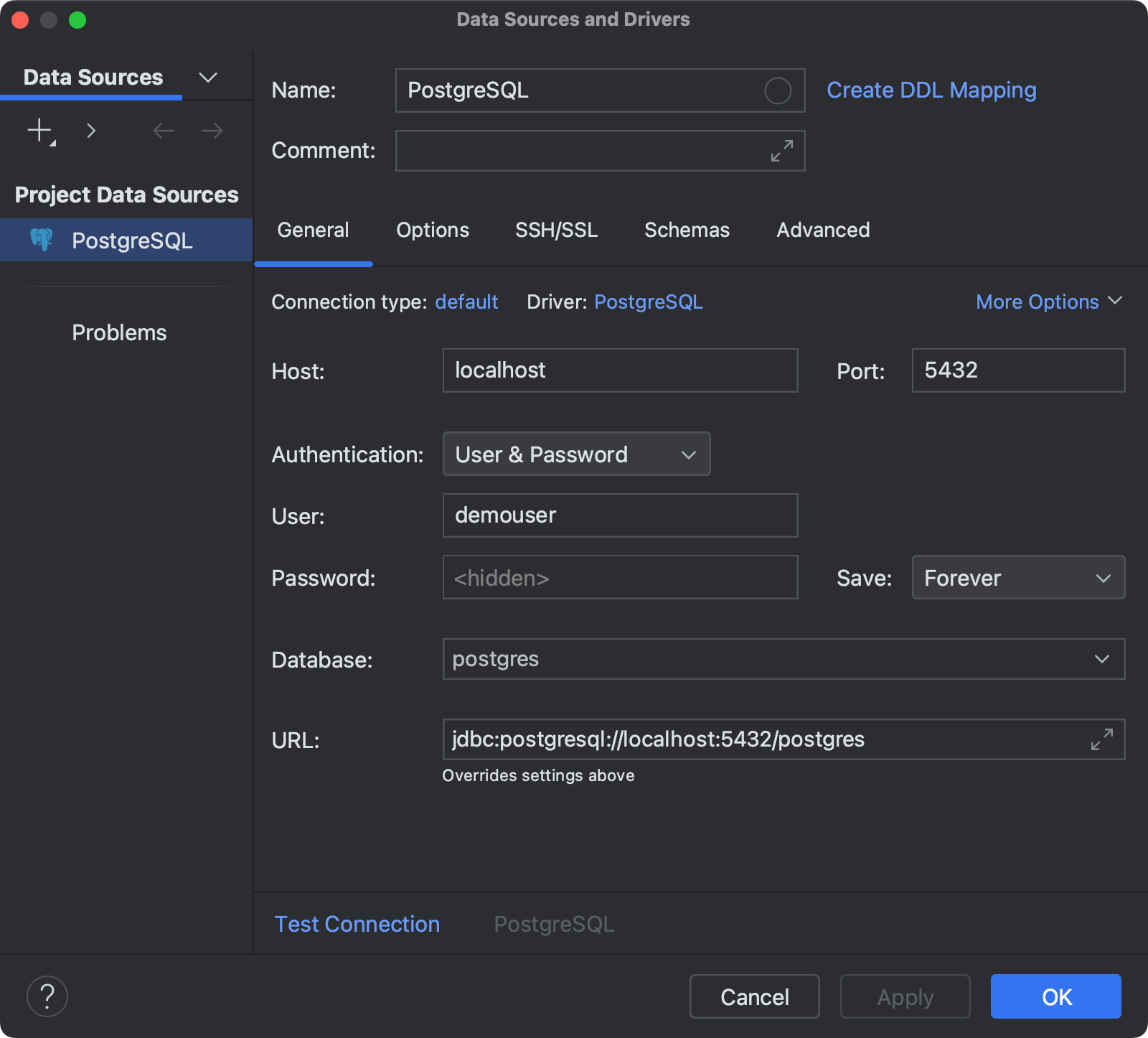
- In the General tab of Data Sources and Drivers dialog right pane, specify the driver and connection type.
- In the Driver list, leave the default driver option, unless another driver is required for your connection.
- From the Connection type list, select the connection type depending on the connection details that you have:
- default : connect by using Host , Port , Database , and URL .
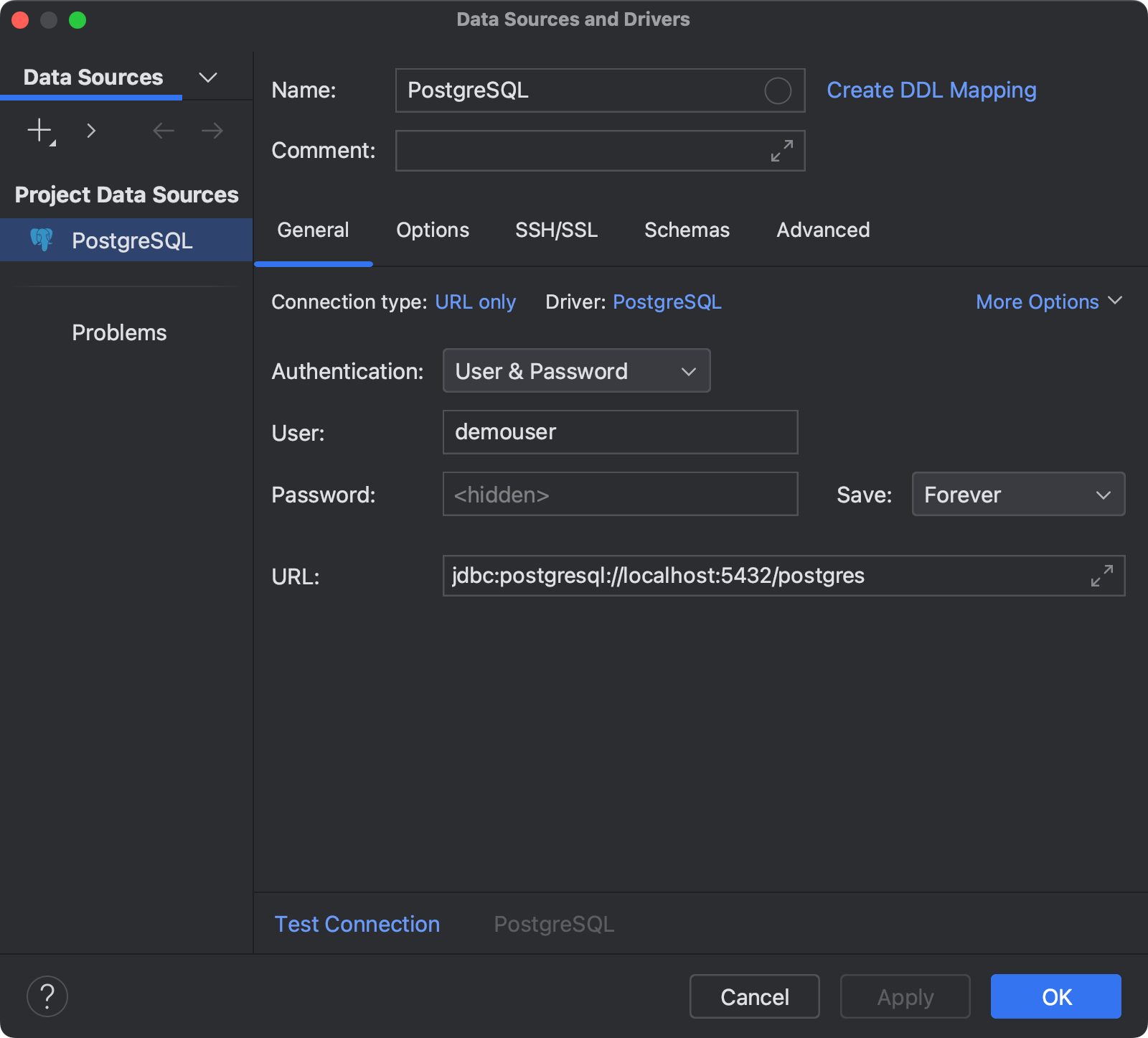
- URL only : connect by using only the URL .
For the URL only connection type, the JDBC URL that you enter is used as is.
For the other connection types, the JDBC URL is broken down into connection details. You can either specify them separately and use the automatically generated URL, or you can enter the URL directly in the corresponding field.
 You can also use your drivers for the database instead of the provided ones. For more information about connecting to a database with your driver, refer to Add a user driver to an existing connection. If there is no Download missing driver files link, then you already have the required drivers.
- In the Host field, type your server address.
- In the Port field, type the port of PostgreSQL. The default port is 5432. Real port numbers might be different on your system. Verify that you use a correct port number with your database administrator, server settings, or hosting provider.
- From the Authentication list, select the authentication method that you want to use to authenticate the connection. The following options are available:
- pgpass : by using the pgpass file. You can store this file in the user’s home directory. You can read more about the password file and its location in The Password File at postgresql.org.
- User & Password : by using your login and password.
- No auth : authentication is not required.
- In the User and Password fields, type your user credentials. To use no password, leave the Password field empty. To delete a once entered password, right-click the Password field and select Set Empty .
- In the Database field, type the database name to which you want to connect.
- In the URL field, IntelliJ IDEA generates the JDBC URL automatically using the values of other connection settings. If you need to use a JDBC URL with certain additional settings, paste it in the URL field. The general URL to use is as follows:
- Format: jdbc:postgresql://:/
- Example: jdbc:postgresql://127.0.0.1:5432/myDatabase
For more information about the URL format, refer to the PostgreSQL official documentation.
- From the Authentication list, select the authentication method that you want to use to authenticate the connection. The following options are available:
- User & Password : by using your login and password.
- No auth : authentication is not required.
- In the User and Password fields, type your user credentials. To use no password, leave the Password field empty. To delete a once entered password, right-click the Password field and select Set Empty .
- In the URL field, IntelliJ IDEA generates the JDBC URL automatically using the values of other connection settings. If you need to use a JDBC URL with certain additional settings, paste it in the URL field. For more information about the URL format, refer to the PostgreSQL official documentation.
For the reference information about connection settings and properties on the General and other tabs of Data Sources and Drivers dialog ( Shift+Enter ), see Connection settings and DBMS-specific properties.
 In case of any connection issues, refer to the Cannot connect to a database page.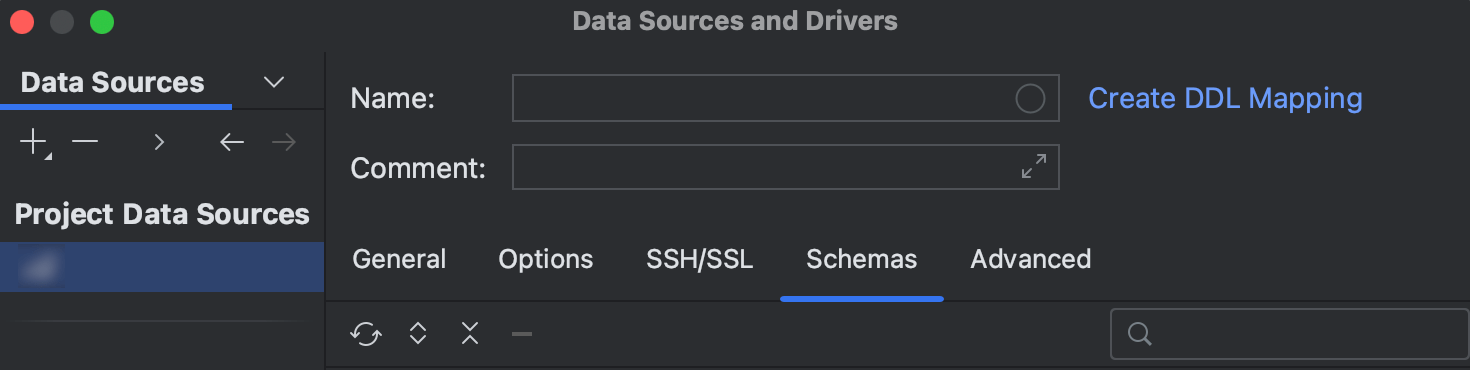
- For more information about the Database tool window, see the corresponding reference topic. To see more databases and schemas under your new data source node, click the N of M button and select the ones you need. IntelliJ IDEA will introspect and show them.
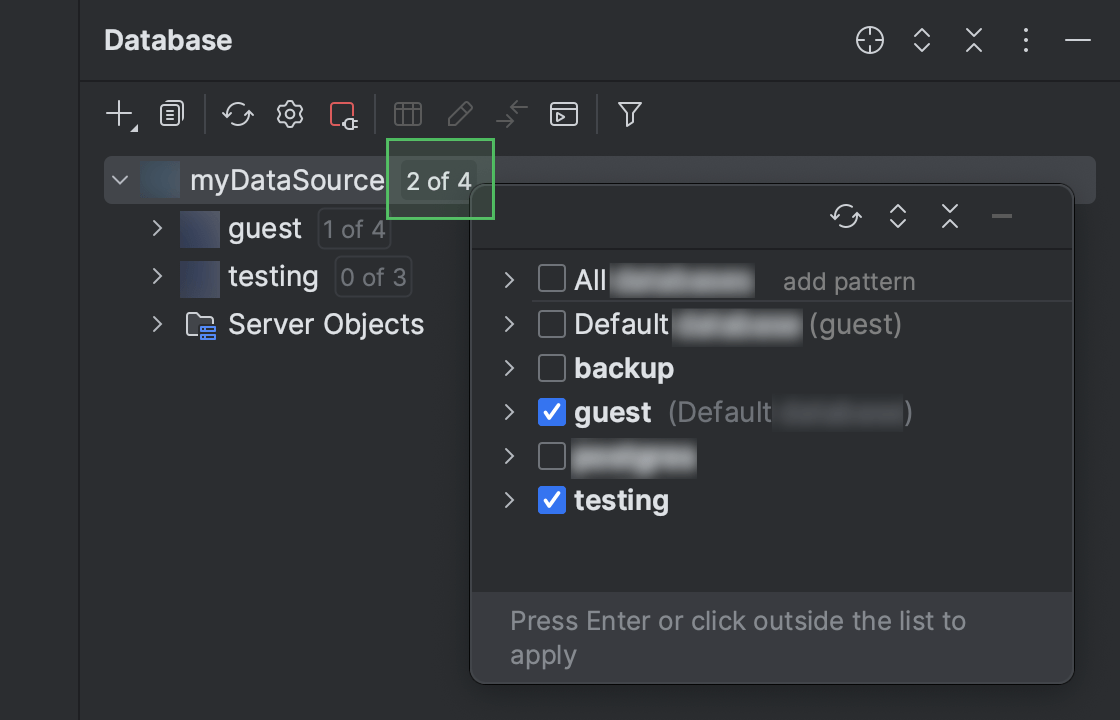
- For more information about working with database objects in IntelliJ IDEA, refer to Database objects.
- To write and run queries, open the default query console by clicking the data source and pressing F4 .
- To view and edit data of a database object, open Data editor and viewer by double-clicking the object.
Connection settings and DBMS-specific properties
Connection settings
For the reference information about connection settings (for example, Host , Port , and so on) on the General and other tabs of Data Sources and Drivers dialog ( Shift+Enter ), see Data source settings.
Какие скрипты использовать в intellij idea чтобы удалить и создать базу данных PostgresQL

хочу удалить и затем заново создать базу данных, но выскакивает drop : Имя «drop» не распознано как имя командлета, функции, файла сценария или выполняемой программы. Проверьте правильность написания имени, а также наличие и правильность пути, пос ле чего повторите попытку. строка:1 знак:1 drop databases; CategoryInfo : ObjectNotFound: (drop:String) [], CommandNotFoundException FullyQualifiedErrorId : CommandNotFoundException Только обучаюсь и поэтому не пойму как правильно писать скрипты. Делаю всё через intellij idea
Комментарии (5)
- популярные
- новые
- старые
Для того, чтобы оставить комментарий Вы должны авторизоваться
Justinian Judge в Mega City One Master
2 июня 2023, 11:57
Интересный вопрос, Intellij Idea имеет свой клиент БД, который позволяет подключать существующую БД. Можно ли прям дропнуть БД или создать другую чисто через этот клиент..Интересно. Клиент работы с БД это вкладка Database в Ультимейт или отдельный плагин в Коммюнити, который имеет меню и вид все ту же вкладку. Самое простое это использовать другие клиенты работы с БД, с графическим интерфейсом — pgAdmin или консольный клиент psql То что у тебя на скриншоте это просто терминал Идее, как я понимаю с power shell надстройкой. Ты не можешь просто писать в любом месте SQL команды и ожидать результат. SQL команды пишутся в SQL клиентах. Ребята тебе в комментариях в принципе набросали основные, ну еще DBeaver из универсальных есть.
Уровень 40
2 июня 2023, 05:11
Это ты не в Idea командуешь, а в терминале, так же как если открыл CMD в Windows. Эти команды надо вводить в клиенте постгреса, как его запустить есть на том канале, с которым ты тренируешься 🙂
Уровень 47
1 июня 2023, 20:58

Уровень 47
1 июня 2023, 21:01
что бы управлять бд, удобно подключить ее к idea. а что бы дропнуть базу почему не pgAdmin, зачем выдумывать)
Денис Java Developer
1 июня 2023, 19:10
Ну ты же должен наверное догадаться, что для работы с БД тебе нужен клиент? Например psql Вряд ли конечно.
- Курсы программирования
- Регистрация
- Курс Java
- Помощь по задачам
- Цены
- Задачи-игры
Сообщество
JavaRush — это интерактивный онлайн-курс по изучению Java-программирования c нуля. Он содержит 1200 практических задач с проверкой решения в один клик, необходимый минимум теории по основам Java и мотивирующие фишки, которые помогут пройти курс до конца: игры, опросы, интересные проекты и статьи об эффективном обучении и карьере Java‑девелопера.